Contents —
Every fund has had to stare its own capability in the face.
We had the same choice as everyone else. Rebuild the firm around it, or take the easy road: bolt Claude onto a 2020 operating model, call it "adoption," post about it on LinkedIn. Up and running with Cowork. Ahead of the curve. A few hours saved a week. Then the gains stop.
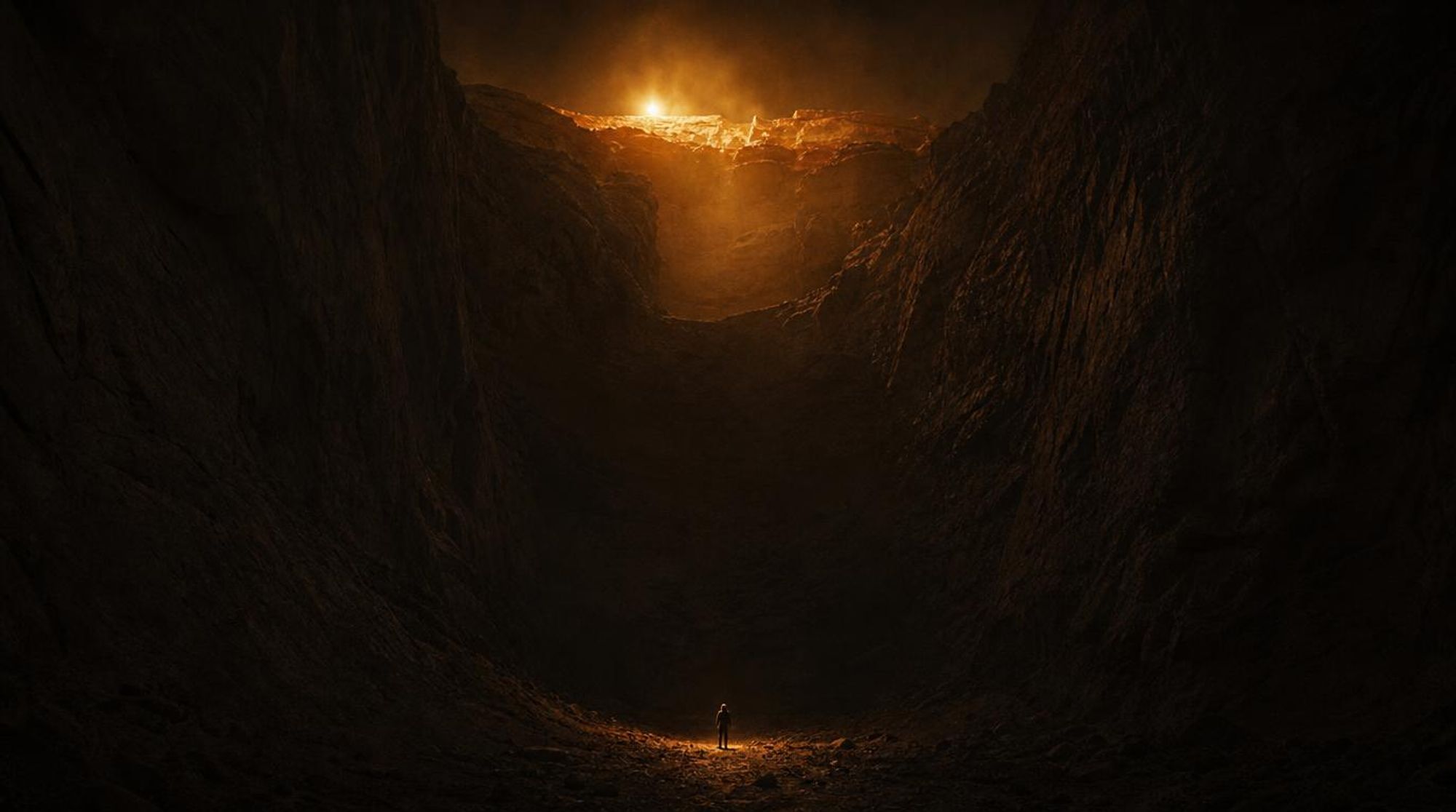
The long road down
There's a reason for that.
Learning an entirely new technology on top of the day job means you get worse before you get better.
It all pays off eventually. It just pays off on the other side of a deep hole you have to climb all the way down into first... and everything down there is either broken or lying to you.
The AI struggle
Learning a new way to work while still doing the old one.
SCROLL TO SEE THE FULL CURVE →
At the moment, everyone feels like they're falling behind. Even the heaviest users – the Claude Max 20x-ers walking to lunch with the laptop half-open, guilty about every token left unspent.
And if they feel behind, the part-timers bolting it on between board meetings have no chance.
You can't climb down there with one eye on the deal flow.
So we stopped looking at new deals, and stripped the investment process down to its parts. We pulled out every step and rebuilt each one with AI at the centre of it.
We were looking for two things. What AI could do better than us, and what that would free us up to spend more time on.
Taking it apart made it obvious the old way had been holding on for dear life. More companies were coming through than it could handle properly, and when you're triaging by hand, you miss things.
The full teardown, step by step, is its own story. So is what it all runs on – years of our own data and decisions turned into something the system can reason with. We'll publish both shortly.
Outsiders can't back insiders
We back one kind of founder: the insider. The operator who spent ten years on the factory floor and is now rebuilding the floor. Not someone who's never been near the problem, armed with Claude and a spare weekend.
Then we looked at our own firm.
Ten years and eighty-five investments deep at seed, we were the insider. Thousands of founders have sat across that table from us, which is the only way anyone learns to read one.
We knew how to assess and invest in an AI company. Whether the value actually ends up with them or with the lab they're renting the intelligence from.
What we hadn't done was run a firm on it. So who were we to sit across the table and judge someone who had?
The rebuild doesn't make us AI founders – but it's a long way past a subscription. We could have gone shopping for a Harmonic or a Kruncher or another off-the-shelf tool, wired it in and called it done. Instead we took a whole firm apart and built it back around the technology, and we felt where it breaks and where it actually earns its keep.
It's also what we look for now. Plenty of companies are AI on the outside and manual on the inside, and they'll be slower and burn more than the ones running it through their operations too. In a few years nobody will be impressed by it. It'll just be how companies are built.
What we could hand over
We'd been running a rough version of this since GPT-4 launched in March 2023. Dozens of n8n workflows stitched together, running basic research agents against our investment mandate. Pretty ugly, but it worked, and it screened real deals the whole time. Most of what we know about the hard parts we learned from the version that barely worked.
Building the agents is hard in itself. Wiring them together so a deal runs end to end, getting them to read a deck properly, stopping them inventing things, figuring out what to do with the thousands of edge cases. That part is engineering, and engineering is logical and solvable.
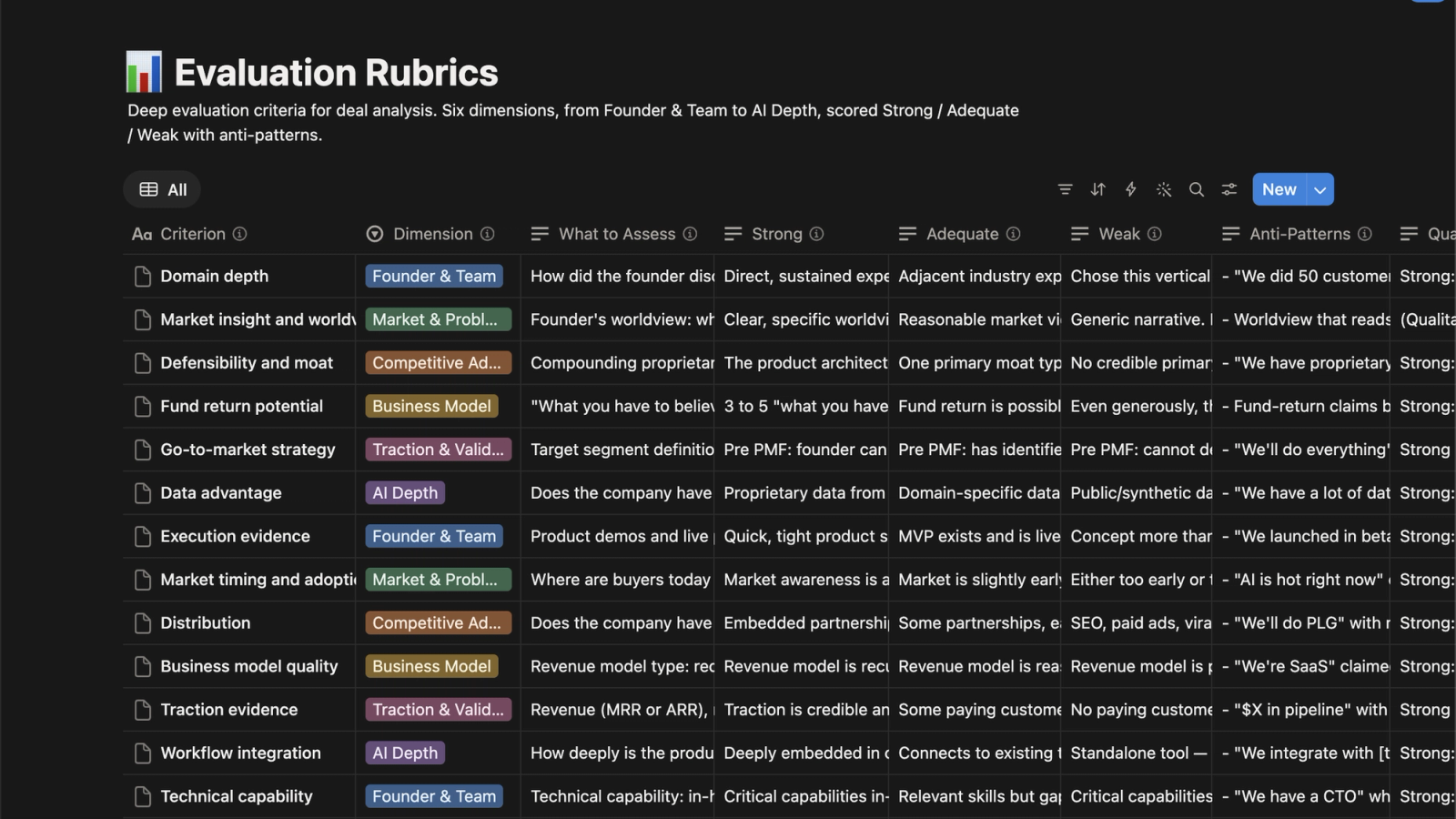
The hardest part was codifying what we believe. A lot of what we call "judgement" isn't all that mysterious. We know how we weigh a market, and what we make of a founder's track record. It had just never been written down, because it never had to be. It sat in our heads and got argued out deal by deal. So we dragged it into the open, scored what could be scored across thirty criteria, and handed that to AI.
What we couldn't
We kept the actual decision. No amount of prompting or context gets you the judgement of someone who's spent a decade at seed and gone deep on thousands of companies (before AI was a mere glint in Sam Altman's eye).
Go back to that founder. Ten years on a factory floor, watching an old process break the same way, knowing what would fix it but not enfranchised to try. AI can't read this founder. There is no dataset for the new "right" that could change the industry.
The moment a thing can be measured, it becomes a commodity. AI took sourcing and screening and research and made them close to free, so every fund now arrives at the same conclusion at the same time and pays the same price for the same deal. The snake eats its tail. Whatever edge used to sit in the analysis is gone.
Consensus thinking and artificial intelligence make a poisonous cocktail. Trained only on the past, a model reads the weird and the brilliant as noise and deletes it. A human has to catch the hallucinations, and the quirks of brilliance it's built to discard, then fish the outliers back out of the too-hard basket.
Those are the ones that return a fund. They never look like the companies before them, which is exactly what makes them fund returners. They're the deals a partner had to fight bloody-fisted in a boardroom for.
At Series A the algorithm reads the numbers. At seed someone has to read the room.
Taste, instinct, whatever you want to call the thing no dataset has. That's all VC is now. Applying it at seed is the last unpriced trade in venture. The only problem is: you have to back someone on no data.
And it was never really about the idea. Ideas are cheap, and they mutate the second they meet a customer. You're backing the brain and the heart of a founder before the market has made them anything. Can they see what nobody else has spotted yet? Will they pivot five times to get it right, in a market that moves every week?
Someone has to go first.
The white hot core of venture, and the mechanically correct way to run it, is the same as it was a half-century ago. Back the right person, early, at a fair price, and pick up the phone when they need you.
Where the hours go
You only get outlier returns at seed if you're right about something before the market is. That means a real view on where a category ends up in five years, and you can't outsource that to an AI trained on the past. Building that view is where most of our hours go now.
AI helps us build it. It goes and finds the evidence for a specific claim. It holds everything we've ever thought about a category in one place, the notes, the half-formed brainwaves, every conversation with a founder in the space. A new deal gets read against all of it, rather than against whatever we happen to remember. The view is still ours.
The rest of the hours go to founders. They find out whether we're in within days, not after six weeks of wondering. Mid-raise is a horrible time to be left hanging, and it's also when a founder is working out who to trust. The hours go into sitting with them, getting a read on what makes them tick, working out whether we want the same thing out of the next ten years.
And the ones we take forward get the whole firm: deep industry research, customer calls, GTM analysis, a day across the table. We fly in and dig into the founders and the business properly. The ones we've already backed get the same level of attention, long after the cheque clears.
The time for all that had to come from somewhere. Handing over everything a machine could do gave us back 70% of it. It's better than us at the screening and the market research. We see more companies than we ever could before, and the screen never gets tired. It also has no ego and no FOMO, and no soft spot for a friend-of-a-friend intro.
For most of this industry's history the noise has been the work. You spend the week getting through it, and finding a fund-returner is one task among many. Now every working hour is an act of judgement, which is the thing an LP was always paying for but could never really put their finger on.
Mostly art, a little science, no religion
We don't kneel at AI's altar. We can see the hype for what it is, use the technology where it works, and walk away from the parts that don't. What we are evangelical about is seed: finding founders early, supporting them intensively, using the technology that helps them now.
None of this is easy. We're a small team now, covering the ground of one ten times the size.
That's what we did all this for. To buy more hours in the chair opposite a founder.

Sam Henderson
20 years of GTM and ops expertise across startups and ASX-listed tech companies.